

Your Identity Is Running the Show — And Your Nervous System Installed It
Apr 15, 2026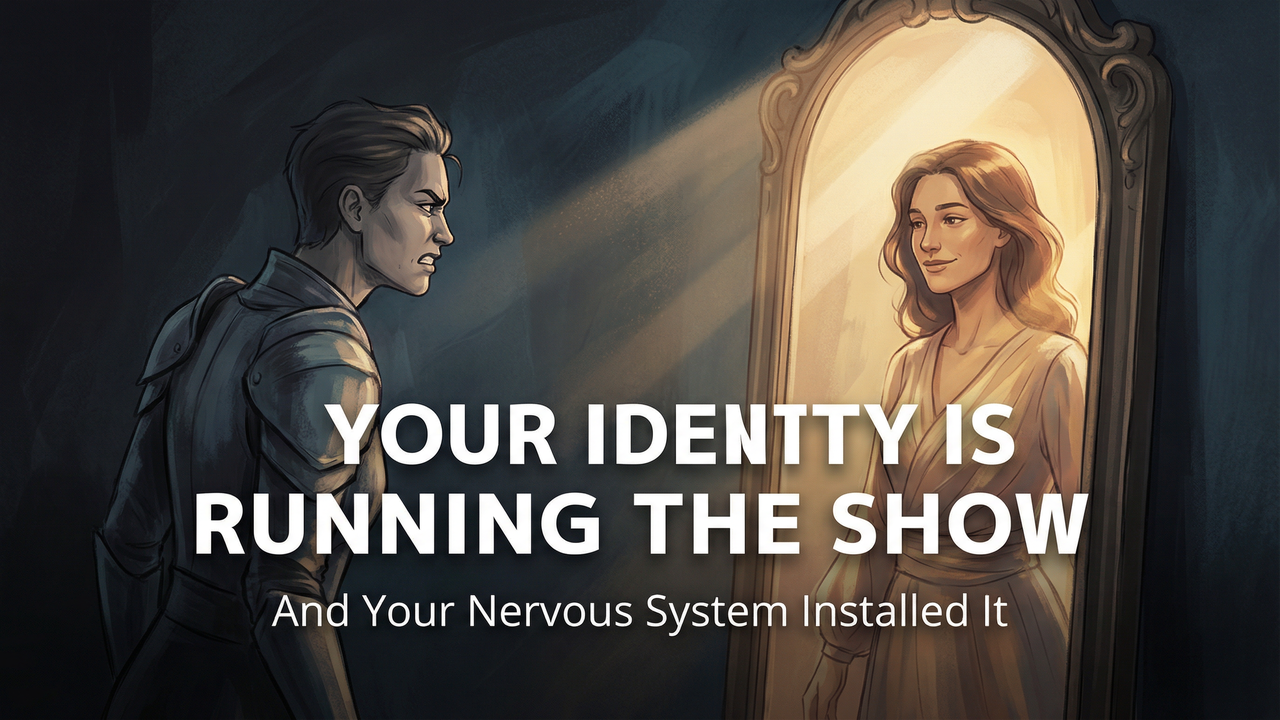
Your Identity Is Running the Show — And Your Nervous System Installed It
There is a version of you that you built to survive.
You might not remember building it. It happened slowly, over years, in response to what life demanded. You learned what got approval. You learned what kept you safe. You learned what made people stay. And piece by piece, you assembled an identity around those lessons.
That identity became your operating system. It told you how to show up, what to prioritize, how much to give, and when to push through. It was effective. It got you promotions, respect, results. It made you the person everyone could count on.
But here is the thing no one tells you.
That identity was installed by your nervous system. And it was installed during survival.
Which means the person you have been performing as, the one who holds it together, who leads under pressure, who never drops the ball, is not your highest self. It is your most protected self. And there is a significant difference.
I know this because I lived it.
The identity I built to survive.
When I was climbing the corporate ladder, I built an identity that was bulletproof. Or at least it looked that way. I was the closer. The leader. The one who could handle anything. I hit seven figures. I was nationally ranked. I showed up every single day with a level of intensity that most people could not sustain.
And I was proud of that identity. It felt like me. It felt like strength.
But underneath it, my nervous system was running a very different program. It was running fear. It was running urgency. It was running the belief that if I ever stopped performing, I would lose everything. Not just success. Safety. Belonging. Worth.
That belief was not something I chose. It was something my nervous system learned through years of experience. Through trauma. Through environments where my value was tied to my output. Through moments where letting my guard down led to pain.
So my body did what bodies do. It adapted. It built an identity that could survive those conditions. And then it locked that identity in place.
Even after the conditions changed, even after I had achieved more than I ever imagined, even after I survived cancer and near-death experiences, that identity kept running. Because the nervous system does not update automatically. It does not care that your circumstances have changed. It cares about what it learned. And it will keep running the old program until something intervenes at the level of the body.
How your nervous system builds identity.
This is where the science gets fascinating.
Your brain is a prediction machine. It does not wait for reality to happen and then respond. It predicts what is going to happen based on past experience and then generates your perception accordingly. This is called predictive processing, and it is one of the most important discoveries in modern neuroscience.
Your nervous system is constantly asking: based on everything I have experienced, what is most likely to happen next? And then it prepares your body for that prediction. If your history says that love comes with conditions, your system will brace every time someone gets close. If your history says that rest leads to consequences, your system will generate anxiety every time you slow down. If your history says that your worth depends on your performance, your system will flood you with urgency every time you are not producing.
Over time, these predictions become automatic. They become your default state. They become your identity.
You do not wake up and choose to be anxious or driven or hypervigilant. Your nervous system chose for you, based on data it collected years or decades ago. And because neuroplasticity strengthens whatever pathways are used most frequently, those patterns get deeper and more entrenched with every repetition.
This is why identity feels so solid. It is not just a story you tell yourself. It is a neural architecture. It is wired into your body. Your muscles hold it. Your breath patterns reflect it. Your posture embodies it. Your emotional reactions express it.
And this is why you cannot change identity through thought alone.
The gap between who you are and who your nervous system thinks you are.
Here is where most people get stuck.
They do the personal development work. They read the books. They go to the seminars. They write new affirmations and set new intentions. And for a while, it feels like something is shifting. But then life gets stressful, or someone pushes a button, or they try to rest, and the old identity comes roaring back.
This is not failure. This is the nervous system doing exactly what it was designed to do. It is returning to the identity it recognizes as safe, even if that identity is built on survival.
The conscious mind can imagine a new version of you. But the nervous system will only follow what it has experienced as true. And if your body has never experienced the felt sense of being safe without performing, being worthy without producing, being loved without earning it, then no amount of visualization will make that identity stick.
This is the gap. The gap between who you want to be and who your nervous system will allow you to be. And closing that gap requires more than mindset. It requires nervous system recalibration.
What recalibration actually looks like:
When I developed The Peace Protocol, I was not trying to create another personal development program. I was trying to solve a problem that I could not think my way out of. The problem was that my identity was fused with survival, and my nervous system would not let me be anyone else.
The Peace Protocol addresses this through four pillars, and the order matters.
First, we stabilize the nervous system. You cannot install a new identity on an unstable foundation. If your system is in chronic fight or flight, it will reject anything that does not match its current state. Stabilization means helping your body experience safety. Real, felt, embodied safety. Through breathwork, somatic practices, and vagal toning, we create the conditions for your system to soften its grip. This is not about forcing calm. It is about giving your body enough repeated experiences of regulation that it starts to trust a new baseline.
Second, we separate from reactive thought patterns. This is where you begin to see the old identity for what it is. Not truth. Not you. A pattern. A survival strategy. When you can observe your reactivity without being consumed by it, you stop being run by it. You start to notice the moments when the old identity takes over, the urgency, the people-pleasing, the need to control, and instead of acting from it, you pause. That pause is everything.
Third, we install a new identity rooted in internal certainty. This is not about becoming someone different. It is about uncovering who you are underneath the survival programming. The version of you that does not need external validation to feel worthy. The version that can lead without tension. That can rest without guilt. That can be present without performing. This identity is not aspirational. It is already there. It has just been buried under years of nervous system protection.
Fourth, we train from that identity until it becomes the default. This is the pillar most people skip, and it is the one that makes everything permanent. You practice being the regulated version of yourself in real life. In meetings. In relationships. In moments of stress. And every time you choose regulation over reactivity, you strengthen the new neural pathways. You weaken the old ones. You teach your nervous system that this new identity is not just safe. It is home.
The body tells the truth.
I come back to this because it is the thread that runs through everything.
Your body has been telling you the truth this entire time. The tension you carry is not random. The emotional volatility is not a personality flaw. The exhaustion that no amount of sleep seems to fix is not laziness. These are signals from a nervous system that has been running an identity built for survival, and that identity is costing you more than it is protecting you.
You did not choose this consciously. But you can choose what happens next.
Not by thinking harder. Not by pushing through. Not by adding another layer of performance on top of the one that is already cracking.
By going underneath it. Into the body. Into the nervous system. Into the place where identity actually lives.
I have watched people transform when they finally stop trying to become a better version of their survival self and instead let that self go. It is not easy. It can feel like free fall at first. Because when you release the identity your nervous system has been clinging to, there is a moment of disorientation. A moment where you do not know who you are without the armor.
But that moment is not the end. It is the beginning.
It is the beginning of an identity that is not built on fear. That is not maintained by urgency. That does not require constant performance to feel real.
It is the beginning of peace as a baseline.
And that is what The High Level Life is actually about. Not achieving more. Not optimizing harder. Living from a place where your nervous system is no longer running the show from survival.
So I will leave you with this.
Who are you when you are not performing?
Who are you when the room is empty and no one is watching and there is nothing to prove?
If that question makes your chest tighten, that is your nervous system talking.
And it is worth listening to.
I am Jen Guidry. I work with high performers, leaders, and driven humans who look fine on the outside but feel braced, exhausted, or disconnected on the inside. My work sits at the intersection of nervous system regulation, trauma-informed somatic work, and real-world performance. I am the founder of The High Level Life Method and the creator of The Peace Protocol, a recalibration process that helps people regulate their nervous systems, reclaim clarity, and lead from a grounded, sustainable place.
If you are curious about this work, you can learn more at thehighlevellife.com.
And if something in you knows it is time for a deeper conversation, you can schedule a private call here: Calendly