

Why High Achievers Feel Guilty When They Rest - A nervous system, psychology, and brain science explanation
Mar 04, 2026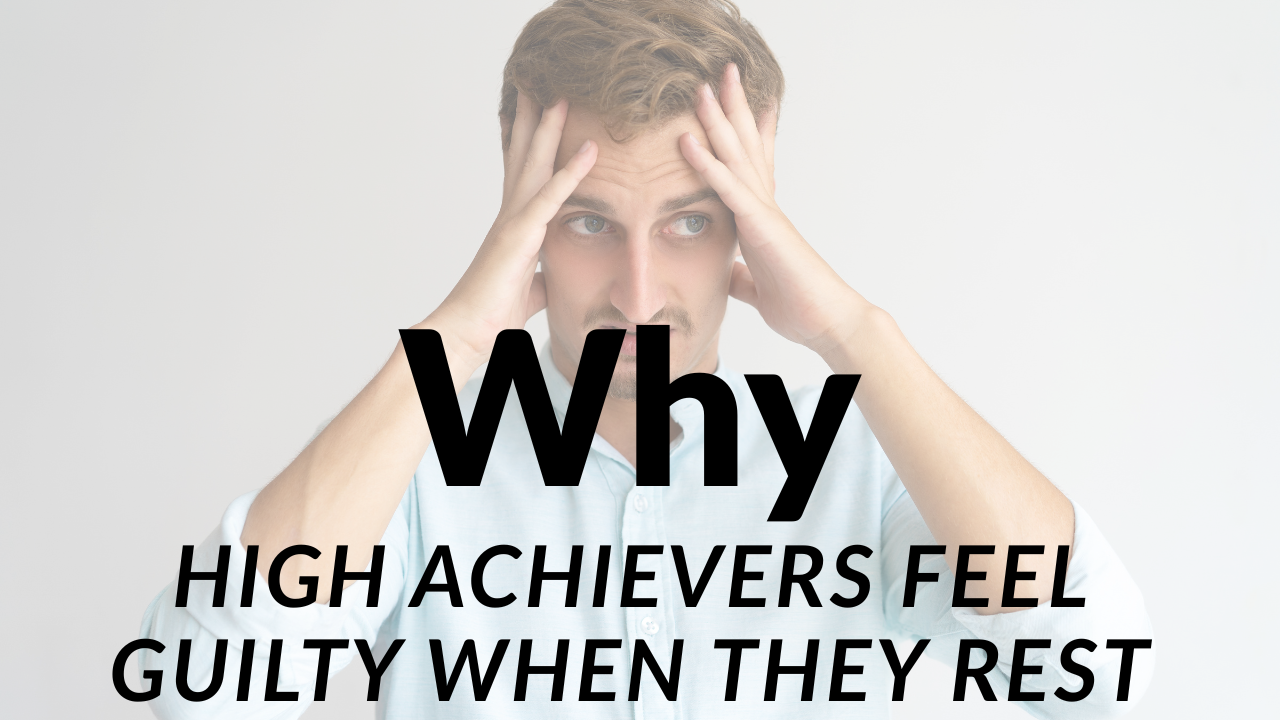
There is a particular kind of guilt that shows up in high performers that often goes unnamed because it hides behind words like discipline, ambition, or drive. It appears in quiet moments, when the day is technically finished but the mind keeps searching for one more task, one more improvement, one more problem to solve. You sit down, your body is tired, yet something inside feels uneasy, almost as if resting is a small betrayal of who you are supposed to be. Many people assume this means they are simply wired to work hard or that they need to learn better boundaries, but the truth is that this reaction is not primarily about willpower or time management. It is a deeply learned biological and psychological pattern that lives in the nervous system and in the way the brain predicts safety, reward, and identity.
To understand why guilt shows up when rest begins, we first have to understand that the brain is not designed to make you happy or relaxed. Its primary job is to help you survive by predicting what actions will keep you safe based on past experience. Over time, your brain builds internal models about how the world works and about who you are within it. If achievement, productivity, and reliability consistently led to praise, success, or emotional security, the brain learned that activity equals stability. This learning process happens through neuroplasticity, the brain’s ability to strengthen pathways that are repeated, meaning the more often you respond to pressure by doing more, the more automatic that response becomes. Eventually the nervous system no longer experiences productivity as a choice. It experiences it as the baseline for safety.
This is where dopamine comes into the conversation, because dopamine is often misunderstood as a simple “pleasure chemical,” when in reality it functions more like a motivation and prediction system. Dopamine spikes are not just about reward itself but about the anticipation of progress toward a goal. When you check something off a list, close a deal, finish a project, or receive external validation, your brain marks that sequence as successful and encourages you to repeat it. Over time, high achievers become accustomed to a steady cycle of micro-rewards tied to forward motion. The nervous system becomes calibrated to expect movement, and stillness begins to feel unfamiliar, which the brain interprets as uncertainty.
This leads to something called prediction error, a concept from neuroscience that explains why rest can feel uncomfortable even when logically it makes sense. The brain constantly predicts what should happen next based on established patterns. If your internal model expects activity and you suddenly stop, the brain registers a mismatch between expectation and reality. That mismatch creates discomfort, and the mind quickly attempts to reduce it by pushing you back toward familiar behavior. In practical terms, this is why you might sit down to relax and immediately feel the urge to check email, plan tomorrow, or start reorganizing something that did not need reorganizing. The brain is not trying to sabotage you. It is trying to restore predictability.
What complicates this even further is identity reinforcement, which happens at a psychological level beyond simple habit. Many high performers unconsciously build a sense of self around being competent, capable, and needed. This identity is often reinforced socially, because the world responds positively when you are reliable and productive. People praise your work ethic. Opportunities increase. Your value becomes mirrored back to you through output. Over years or decades, the line between “what I do” and “who I am” begins to blur. Rest then becomes complicated, because when you stop doing, the nervous system briefly loses the familiar signals that confirm identity. The feeling that arises is not only boredom or restlessness. It is often guilt, which is the emotional marker that tells you you are stepping outside an internalized standard.
From a nervous system perspective, guilt here is not a moral issue. It is a regulatory response. Emotional states often emerge to guide behavior back toward what the brain believes is safe and socially aligned. If productivity has been linked with belonging or self-worth, then resting can trigger a subtle alarm that says something like, “You should be doing more.” This message may feel personal, but biologically it is an adaptive pattern that once helped you succeed. The system is attempting to keep you within the boundaries that historically produced positive outcomes.
There is also an important layer involving stress chemistry. High achievers often operate with elevated sympathetic nervous system activation, which supports focus, mobilization, and action. When this state persists for long periods, the body adapts to it and begins to treat higher activation as normal. Parasympathetic states, which support recovery and integration, may feel strangely flat or uncomfortable by comparison. This is why some people describe rest as feeling unproductive or even emotionally heavy. The body has normalized intensity, so calm can feel like absence rather than nourishment. The contrast itself becomes unsettling, and the mind interprets this sensation as a signal that something is wrong.
Psychologically, there is another hidden factor that few people talk about. Rest removes distraction. When doing stops, unresolved thoughts and emotions often rise into awareness. The nervous system, which has relied on busyness as a form of regulation, suddenly encounters open space. That space can bring clarity, but it can also bring vulnerability. For someone accustomed to staying in motion, this can feel unfamiliar enough to trigger subtle anxiety, which then gets mislabeled as guilt. The mind may say, “I should be working,” when what it really means is, “This quiet feels exposed.”
Understanding this pattern changes how we approach recovery, because the solution is not simply forcing yourself to rest longer. If the nervous system interprets rest as a threat to identity or safety, then pushing into long periods of stillness can backfire. Instead, the goal is to retrain the brain’s prediction system so that moments of rest become familiar and safe. This happens gradually, through small experiences that pair stillness with positive outcomes. Short pauses, intentional breathing, or even moments of simply noticing sensations in the body help the nervous system build new associations. Over time, the brain updates its internal model and stops interpreting rest as a deviation from safety.
It is also helpful to separate worth from output consciously. This does not mean abandoning ambition or lowering standards. It means recognizing that your value does not rise and fall with your level of productivity. Many high achievers find that when this shift begins to happen, work quality actually improves because action comes from clarity rather than internal pressure. The nervous system becomes more flexible, able to move into high performance when needed and then return to rest without friction.
One of the most powerful moments in this process occurs when a person realizes that guilt during rest is not evidence that they are failing but evidence that their system is learning something new. The discomfort is a sign of rewiring, much like soreness when beginning a new physical training routine. The brain is adjusting to a different rhythm, one where safety is not entirely dependent on motion.
Long-term, this shift changes not only how you rest but how you lead and create. When action is driven by choice instead of compulsion, decision-making becomes cleaner and emotional reactivity decreases. You begin to notice that your best ideas often emerge in states of calm presence rather than urgency. Neuroscience supports this observation, showing that creative insight and integration frequently occur when the brain is not actively focused on problem-solving but is allowed to wander and connect information in the background.
The deeper truth is that many high achievers do not need to learn how to work harder. They need to learn how to exist without constantly proving they deserve to rest. This is not a loss of drive. It is the maturation of drive, where ambition is supported by regulation instead of fueled by tension.
If you notice guilt appearing when you slow down, it can be helpful to ask a different question. Instead of “Why am I being lazy?” try asking, “What expectation is my nervous system trying to protect right now?” That shift moves the conversation from judgment to curiosity, and curiosity is one of the safest states for the nervous system because it invites exploration instead of resistance.
Over time, the goal is not to eliminate productivity or passion but to expand your internal range so that stillness feels as natural as action. When the brain learns that rest does not threaten identity or survival, guilt loses its grip. What remains is something quieter and more stable, an ability to move between effort and recovery without internal conflict.
And that, more than any productivity strategy, is what creates sustainable performance and genuine peace.
I’m Jen Guidry. I work with high performers, leaders, and driven humans who look fine on the outside but feel braced, exhausted, or disconnected on the inside.
My work sits at the intersection of nervous system regulation, trauma-informed somatic work, and real-world performance. I don’t focus on fixing people or calming them down. I help them restore orientation so their system can finally exhale and respond to life instead of fighting it.
I’m the founder of The High Level Life Method®, a 360° recalibration approach that helps people regulate their nervous systems, reclaim clarity, and lead from a grounded, sustainable place.
If you’re curious about this work, you can learn more at
thehighlevellife.com
And if something in you knows it’s time for a deeper conversation, you can schedule a private call here:
https://calendly.com/jenguidry/intro-zoom-or-phone-call-with-jen-guidry